


Legal Panorama – Parking Scams: Protection of property rights – between the law and abuse
A review of the panel discussion held on 10 November 2025, organised by Sebastian Schwamberger in collaboration with *Die Presse* as part of the *Rechtspanorama* series
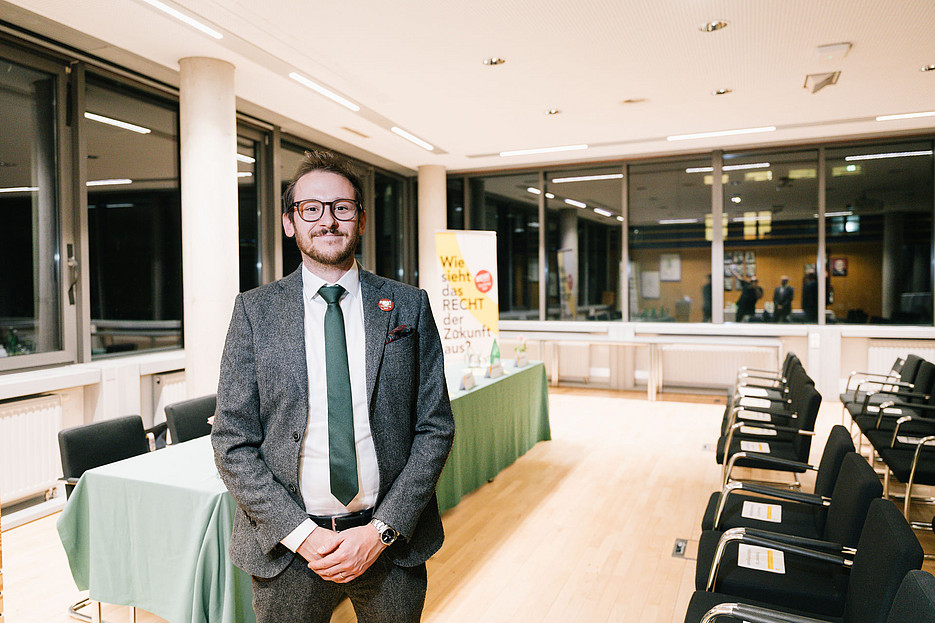
On 10 November 2025, Assistant Professor Dr Sebastian Schwamberger, LL.M., organised a legal forum in collaboration with the daily newspaper *Die Presse* on the topic of ‘Parking rip-offs: protection of property rights between law and abuse’. The panel consisted of Supreme Court President Univ.-Prof. Dr Georg Kodek, LL.M., LStA Mag. Hartmut Melzer (Ministry of Justice), Dr Dominik Prankl, Solicitor (Rosenauer Prankl Barrett Solicitors), Deputy Director Mag.a Schrittwieser (Styrian Chamber of Labour) and Assistant Professor Dr Sebastian Schwamberger, LL.M., and was moderated by Mag. Benedikt Kommenda (Die Presse).
The discussion centred on the sharp rise in parking-related warning letters based on claims of trespass, which are set to be curbed in future by an amendment to the law. The background to this is that, in cases of trespass – such as turning round on private property – motorists are usually sent demands for payment (e.g. 400 euros) under the threat of trespass proceedings. However, those causing the disturbance would usually lose such proceedings and they would end up costing them even more, which is why they generally comply with the demands for payment, albeit not in full. This has led to individual companies specialising in such trespasses and financing themselves by asserting claims for trespass in relation to individual (supermarket) car parks, where it is often not at all apparent that turning round constitutes a trespass.
As a countermeasure, the government is planning not only to reduce lawyers’ fees for such cases, but also to halve the fixed court fees for those who fail to appear at the hearing. The aim, therefore, is to reduce the costs of (impending) trespass proceedings for the trespassers, thereby lowering the amount of the payment demands and thus reducing the financial attractiveness of such business models. In addition, it should be possible to appeal to the Supreme Court so that it can ensure consistent case law or establish a de minimis threshold for claims for disturbance of possession. There was extensive discussion as to whether the proposed reform provides the appropriate means to counter these practices without unduly restricting the enforcement of claims for eviction from premises. A detailed report on the event was published in *Die Presse* on 12 November.